
Timeline & recovery
FUE Hair Transplant Timeline
One of the first questions patients ask is, "when will I actually see my new hair?" It is a fair question — a hair transplant is a considered decision, and knowing what to expect at each stage makes the wait far easier.
FUE (Follicular Unit Extraction) is a minimally invasive procedure. Individual follicles are removed one at a time from the donor area, so there is no linear cut and no stitches. Compared with older FUT (strip) surgery, this means faster healing, less discomfort and a shorter time before you can get back to normal life.
Below is a realistic, stage-by-stage guide to what happens from the day of your procedure through to the full result at around 12 months.
Reviewed by Dr Epameinondas Bonaros, GMC-registered (7566786).
Book a Consultation
Recovery phase
What To Expect After Your Hair Transplant
The first few days after your hair transplant are the most critical — this is when the newly implanted follicles are settling into their new home. Following the aftercare instructions closely during this window has the biggest impact on your final result.
Day zero
Day of the Hair Transplant Procedure
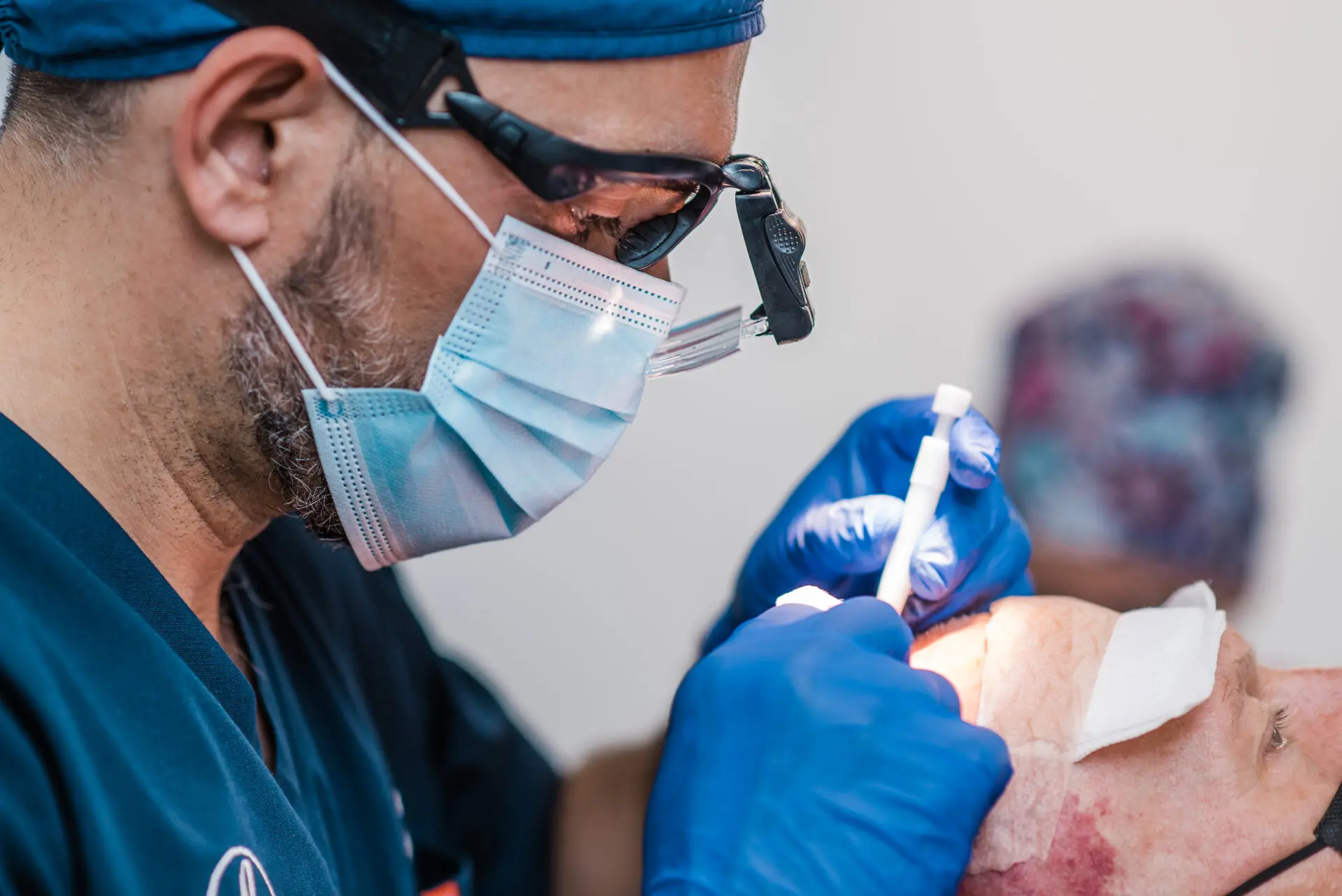
The procedure is carried out under local anaesthetic, so you are fully awake and comfortable throughout. Most patients are surprised by how relaxed the day feels — there is no general anaesthetic and no overnight stay.
- The local anaesthetic keeps the scalp numb for several hours after surgery, so the drive home and the first evening are pain-free.
- As the anaesthetic wears off you may notice mild tingling, a slight burning sensation or tightness — this is normal and settles overnight.
- A light dressing is applied to the donor area and stays on for the first night; the recipient area is left uncovered.
- You will leave with clear written aftercare instructions, the medications you need and a 24/7 helpline for any concerns.
You will spend the rest of the day at home resting with your head elevated at roughly 30 degrees. The clinic will call to check in on you, and small tasks — spraying the recipient area with saline every 30 minutes until bedtime, keeping fingers away from the grafts, sleeping on the disposable pad provided — are all designed to protect the newly implanted follicles during their most vulnerable first hours.
Days 1–3
Days 1 to 3
In the first 72 hours the scalp begins its healing response. You may notice a combination of mild symptoms — all normal and short-lived:
- Swelling around the forehead, temples and occasionally the eyes.
- Redness or pink discolouration across the recipient area.
- Itching as the skin begins to heal and small scabs form.
- Mild discomfort or tightness that responds to the painkillers prescribed.
Scabs form 24 to 72 hours after surgery
Tiny scabs around each implanted graft are a healthy sign of healing. Do not pick or scratch them — they need to soften and shed on their own during your gentle washing routine.
Sleeping with your head elevated at about 30 degrees, following the spray-and-wash routine, and avoiding any pressure on the recipient area are the three things that make the biggest difference during this window.
Most patients feel well enough to take short walks and manage everyday tasks from day one. You should avoid bending down, lifting anything heavy or any activity that raises your heart rate significantly. If swelling appears on day 2 or 3, it is painless and settles within a few days — cool compresses on the forehead and gentle massage from forehead toward the temples help it clear more quickly.
Days 4–10
Days 4 to 10
Any swelling settles fully during this stage and the recipient area starts to look much calmer. The crusts around each graft become drier and begin to lift as you continue with your gentle twice-daily washing routine.
This is the point at which most patients feel comfortable returning to work if their job does not involve heavy physical activity. Strenuous exercise, contact sports and swimming are still off the table.
By 10 to 12 days all crusts should be gone
Once the crusts have cleared, the scalp typically looks close to its pre-surgery appearance — a little pink, but no longer obviously "done".
Weeks 2–3
Weeks 2 to 3
Around this time the transplanted hairs enter a natural resting phase (telogen) and begin to shed. This is expected and completely normal — the hair falls out, but the follicle underneath stays in place, ready to regrow. It can look alarming if you are not prepared for it, which is why so many patients underestimate the psychological side of this stage.
The donor area continues to heal quietly in the background, with any remaining redness fading week by week.
Shock loss — a temporary shedding of some existing hairs near the transplanted area — can also happen around this time. It is a short-lived reaction to the procedure and the follicles regrow normally. In selected patients Dr Bonaros may discuss the option of minoxidil to help stabilise existing hair and support the regrowth phase; whether it is right for you is a decision made together at your consultation.
Months 1–2
Months 1 to 2
You can now resume your normal activity — including the gym, sport and swimming — with no restrictions. The scalp looks and feels like your own again, and there is little outward sign that anything happened.
Beneath the surface the transplanted follicles are still in their resting phase. This "waiting period" is where patience matters most: no visible change on the outside does not mean nothing is happening on the inside.
Some patients notice a very light "peach fuzz" appearance towards the end of month two as the first new hairs prepare to break through. Others see nothing at all until month three or four. Both are entirely normal — regrowth does not happen on a single, uniform schedule and small differences between patients are expected.
Growth timeline
FUE Hair Transplant Growth Timeline
From around month three onwards the visible transformation begins. This is the stage patients look forward to, and it is where the daily-mirror check finally starts to pay off.
Months 3–4
Months 3 to 4
Early regrowth appears — often wispy, fine and lighter in colour than your existing hair. It can look uneven at this stage, with some areas coming through faster than others. This is expected and normalises as more follicles wake up over the following months.
A follow-up appointment is usually scheduled around this point so Dr Bonaros can review progress in person, answer any questions and give you an honest read on how things are developing.
The new hair will thicken gradually over the following months as each shaft matures. Wispy hair is a healthy sign — it means the follicles have survived and are now producing hair on their normal growth cycle.
It is completely normal to compare yourself with other patients' timelines online at this stage. Try not to. Every scalp, donor supply and case plan is different — your own three-month photo is the only reliable benchmark.
Months 5–9
Months 5 to 9
Density builds steadily through this period. By around month six most patients see roughly 50 to 60 per cent of their final density, and by month nine that figure typically climbs to 70 to 80 per cent.
The new hairs continue to thicken, darken and match the surrounding hair more closely. Styling becomes easier, and for many patients this is the point at which friends, family and colleagues start to notice.
6 months
6 Months
Six months is a genuine halfway milestone. The transplanted area is filling in visibly, the hair is behaving normally, and the change compared with your pre-surgery baseline is meaningful.
For many patients this is where confidence starts to return — the point at which the daily reminder of hair loss is replaced with the confidence of a natural, growing head of hair.
There is still meaningful improvement to come between month six and month twelve. Density continues to build, hair shafts thicken, and any small gaps fill in as the last follicles catch up. Six months is a checkpoint, not a finish line.
12 months
12 Months
By around twelve months you can look at your result and consider it complete. The transplanted hair has grown to full length, thickened to its final calibre and settled into its natural growth cycle — indistinguishable from the rest of your hair.
This is the "before and after" comparison patients wait for, and it is why FUE remains the gold-standard technique for a natural, permanent result.
This timeline is just a rough guideline
Individual results vary. Crown and mid-scalp restorations, in particular, can take a little longer — up to 15 to 18 months — to reach their final density. If you have any questions about your own progress, contact us and Dr Bonaros will be happy to review it with you.

Related guides